ObserveNoctilucent clouds
NLC · Special · 24 October 2026 · By
Noctilucent clouds: the highest clouds on Earth
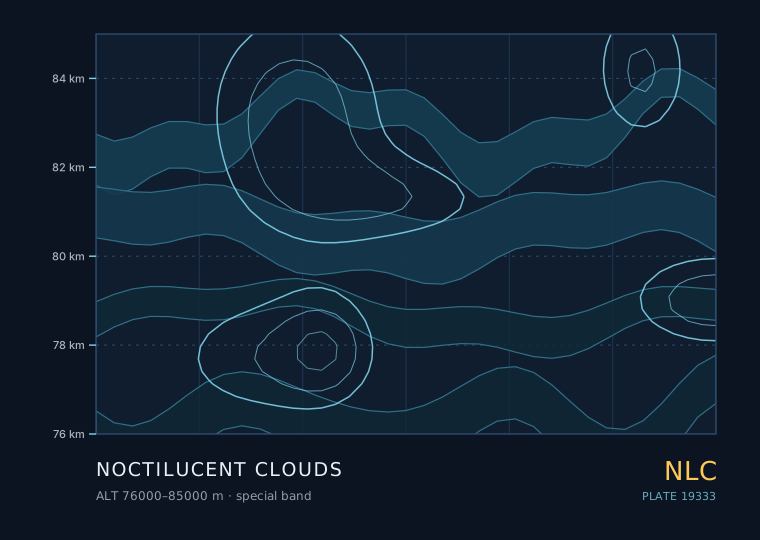
Noctilucent clouds form at 76 to 85 kilometres — around eight times higher than cirrus, and above 99.99 per cent of the atmosphere by mass. They are the highest clouds in the Earth's atmosphere, they exist only in summer, and they are only visible from the ground in a narrow band of latitudes. They are also changing, which is why they matter beyond their beauty.
Noctilucent clouds
Noctilucent clouds
- Band
- Special
- Altitude
- 76 km – 85 km
- Code
- NLC
- Seasonal window
- Northern hemisphere: late May to early August, best in June and July. Southern hemisphere: late November to early February, best in December and January. (Jun, Jul)
- Published
- 24 October 2026
- By
Weather clue
Noctilucent clouds are a mesospheric phenomenon and say nothing about tomorrow's weather at the surface. Their appearance is a function of the season and the state of the upper atmosphere, not of the tropospheric pattern.
How to observe it
- Find solar midnight for your longitude first — the window is centred on it, not on clock midnight.
- Look low towards the pole, 5° to 25° above the horizon, starting about two hours before solar midnight.
- Photograph with the camera braced and a 2-4 second exposure at a high ISO; the clouds are faint and need long exposures.
- Record whether the clouds are still lit while lower cloud has gone dark; that is the defining observation.
Why they need the mesosphere to be coldest in summer
The mesosphere is the coldest part of the atmosphere, reaching −130 °C at about 85 km. Counter-intuitively, it is coldest in summer at high latitudes, and this is a consequence of the global circulation.
In summer, air rises over the summer hemisphere and flows poleward, and as it does so it expands and cools. This means that at 80 km over the Arctic in July, the temperature can be 100 °C colder than it is at the same altitude in January. Noctilucent clouds need that cold: at 80 km the air is so dry that ice can only form below about −120 °C.
When and where to look
Noctilucent clouds are visible only between roughly 50° and 70° latitude in both hemispheres, and only in the summer months of that hemisphere — from late May to early August in the north, and from late November to early February in the south.
They are seen during the deep twilight period after sunset or before sunrise, roughly when the sun is between 6° and 16° below the horizon. At that time the sun still illuminates the mesosphere at 80 km while the troposphere below is in shadow, so the clouds shine pale electric blue against a dark sky.
| Sun elevation | What you see | Best time relative to solar midnight |
|---|---|---|
| Above 0° | Twilight too bright; NLC invisible | Too early or too late |
| 0° to −6° | Sky still bright blue; NLC may appear washed out | About 2 to 3 hours before solar midnight |
| −6° to −16° | Optimum window; NLC show maximum contrast | 1 to 2 hours either side of solar midnight |
| Below −16° | Sky too dark; NLC fade and the troposphere blocks them | After solar midnight, window closes |
What they look like, and what they do not
Noctilucent clouds are pale blue or silvery-white, with a herringbone, banded or wavy structure that is often extremely fine. They do not move fast relative to the stars, and they are not sharply defined at the edges the way tropospheric cloud is.
The key identification test is that they must be illuminated while everything else is dark. If a cloud is still lit but there is cirrus nearby at normal altitude that is also lit, you are looking at ordinary twilight cloud. Noctilucent clouds are the only clouds still catching the sun when the troposphere has gone completely dark.
- Colour. Electric blue to silvery white, never orange or pink.
- Structure. Very fine bands, billows or a herringbone pattern.
- Position. Low in the sky, 5° to 25° above the horizon, towards the pole.
- Timing. Only in deep twilight, in the two to three hours around solar midnight.
- Behaviour. Slow drift, gradually fading as the sun gets lower.
Why they are changing
Noctilucent clouds were first reported in 1885, shortly after the eruption of Krakatoa, and for decades they were widely assumed to be a volcanic curiosity. They are now observed far more often than in the twentieth century, and there are two proposed reasons.
More water vapour in the mesosphere. Methane oxidises in the upper atmosphere to produce water vapour, and atmospheric methane has more than doubled since pre-industrial times. More methane means more water at 80 km, where water vapour is normally almost absent.
Colder mesosphere from CO₂. Carbon dioxide cools the stratosphere and mesosphere by radiating infrared energy to space, even as it warms the surface. A colder mesosphere makes ice formation easier.
Both effects push in the same direction: noctilucent clouds should become more frequent and extend to lower latitudes, and the observations so far are consistent with that. They are, in a real sense, an early visible indicator of changes in the upper atmosphere.
Rules of thumb
- Noctilucent clouds form at 76-85 km, above 99.99 per cent of the atmosphere by mass.
- They require a mesosphere below about −120 °C, which only happens at high latitudes in summer.
- Visible only in deep twilight, when the sun is 6° to 16° below the horizon, near solar midnight.
- They occur between roughly 50° and 70° latitude, in the local summer months.
- They are becoming more frequent, consistent with rising methane and a cooling mesosphere.
| The other cloud | Comparison — Noctilucent clouds |
|---|---|
| 暮光中被照亮的卷云 · Cirrus lit at twilight | Cirrus at normal altitude stays lit for only a few minutes after sunset and goes dark well before the deep twilight window; noctilucent clouds are still lit when everything else is black. |
| 极光 · Aurora | Aurora has green, red or purple curtains and moves and flickers on a timescale of seconds; noctilucent clouds are pale blue, structured, and drift slowly. |
The two or three genera this one is most often confused with, and the single feature that separates them.
Observation questions
Why can I only see them in summer?
Because their formation needs a mesosphere below about -120 °C, and counter-intuitively the mesosphere is coldest in summer at high latitudes. Summer air rising over the summer hemisphere expands and cools as it moves poleward, which is what chills the 80 km level.
Are they a sign of anything at ground level?
No. Noctilucent clouds are a mesospheric phenomenon and carry no information about the tropospheric weather pattern. Their value as an observation is as an indicator of the state of the upper atmosphere, not as a forecast.